

Quick Answer
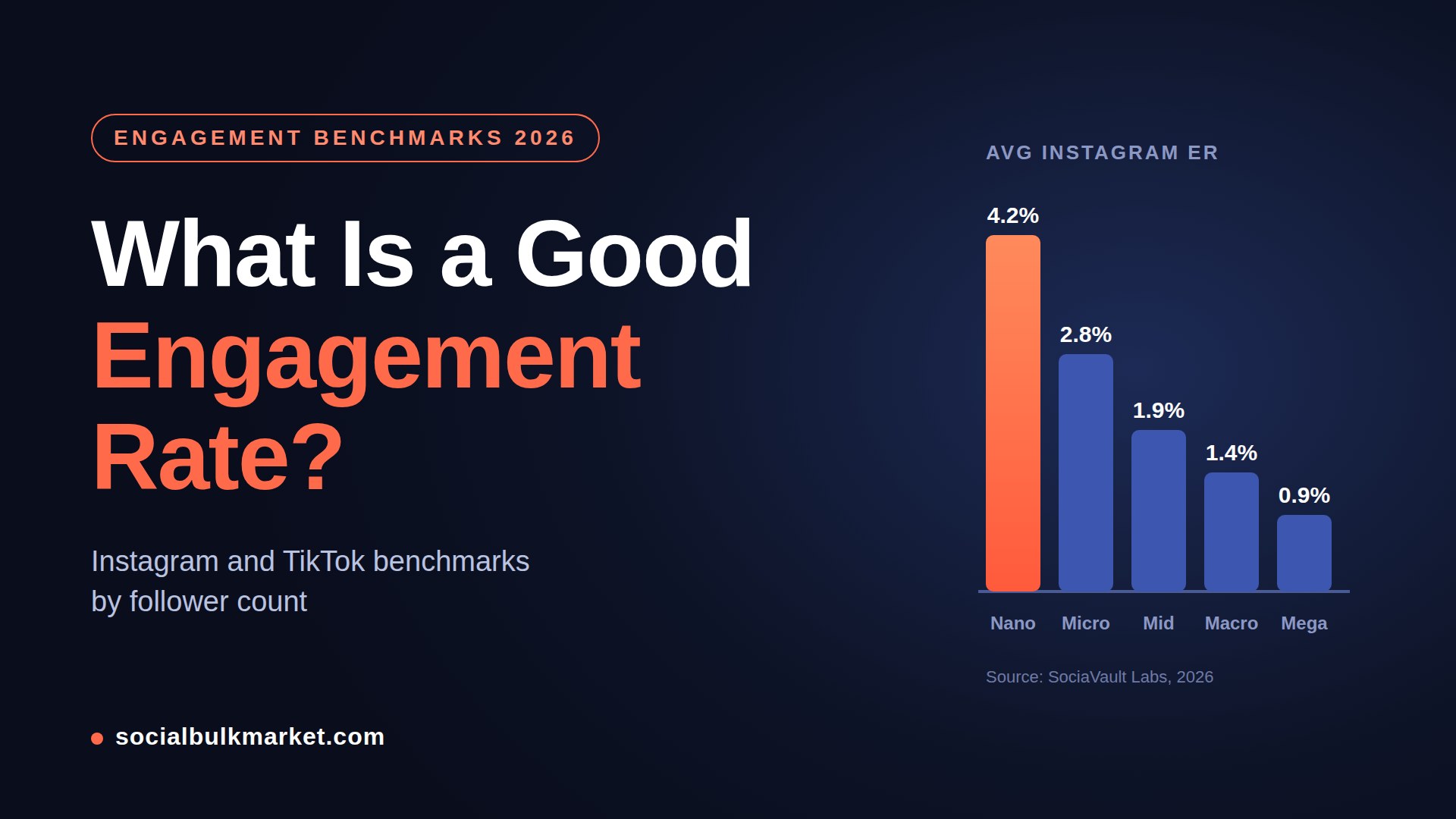
What is a good engagement rate? On Instagram, it depends on your size. Per SociaVault Labs' 50,000-account study, 5%+ is good for nano accounts (1K–10K followers), 3.5%+ for micro, 2.5%+ for mid-tier, 1.8%+ for macro, and 1.2%+ for mega accounts. To find yours, divide likes plus comments by followers and multiply by 100.
If your analytics show a 2.4% engagement rate, it is hard to know whether that is good or bad. Forget outdated advice: what is a good engagement rate depends on your follower count, your niche, and the type of content you make. In this guide, we cover the 2026 benchmarks, the right way to calculate your rate, and the common mistakes that drag it down.
What Is a Good Engagement Rate? Benchmarks by Follower Count
So what is a good engagement rate for Instagram accounts in your niche? First, you should consider your follower segment. The mathematical truth about social media is quite clear: as the account grows, the overall percentage of its engagement will decrease automatically. It’s easy to organize cozy conversations for an account with 5,000 followers, while an account with 400,000 followers works with passers-by.
Here is the clean structure of Instagram engagement rate benchmarks according to the number of followers:
Niche choice is also another huge factor. Content relating to education usually registers a 3.8% engagement rate, whereas high-end beauty products and retail stores get about 1.7%, thanks to overfilled feeds. If you’re analyzing how well your account is doing, always take into consideration similar-sized and categorized accounts before changing tactics. Explore our services page to find tailored engagement solutions designed for every tier.
How to Calculate Your Instagram Engagement Rate
If you are wondering, 'What is a good engagement rate on Instagram?', you have to use metrics consistently. Instead of using a single viral post, calculate the average performance across your last 12 to 30 posts.
This is the standard formula used by successful creators and agencies:
Sum your interactions: Sum up the number of likes and comments on a certain post.
(Note: Saves and shares are not visible on other people's posts, so public calculations use likes and comments only. For your own account, Instagram Insights shows saves and shares as well.)
Divide by follower count: To calculate the interaction per follower, you simply need to divide the total interactions by your number of followers.
Multiply by 100: To find the percentage, all you have to do is multiply the answer by 100.
Worked example: If you get 120 likes and 15 comments on an account that has 4,500 followers. The engagement rate can be calculated in the following way: (120 + 15) ÷ 4,500 × 100 = 3.0%. This puts you in a healthy range for a nano creator.
What Is a Good Engagement Rate on TikTok?
As you build your social media presence, you will see that what is a good engagement rate on TikTok will be quite different from what works on Instagram. TikTok engagement rates usually run higher than Instagram’s, because the For You Page shows videos to people who do not follow you yet. The benchmarks below come from SociaVault Labs’ 2026 data, calculated as likes, comments, and shares divided by followers.
| Follower Tier | Median TikTok ER | Top 25% of Accounts |
|---|---|---|
| Nano (1K–10K) | 7.8% | 12.3%+ |
| Micro (10K–50K) | 5.2% | 8.1%+ |
| Mid (50K–100K) | 3.9% | 6.0%+ |
| Macro (100K–500K) | 2.7% | 4.2%+ |
| Mega (500K+) | 1.8% | 2.9%+ |
Source: SociaVault Labs, 2026. TikTok ER = (likes + comments + shares) ÷ followers × 100.
While TikTok rewards rapid short-form video consumption, maintaining consistent interaction needs regular posting and strong native storytelling.
Why Is My Engagement Rate Dropping?
If your analytics are going down, don’t worry right away. A low engagement rate is a common problem, but it usually comes from one of a few clear reasons:
Follower Growth Mismatch: When you are gaining more followers but aren’t receiving enough engagement on the posts, the engagement rate is bound to decrease.
Ghost and Inactive Followers: Inactive or bot accounts add to your follower count but never like or comment, which pulls your rate down over time.
Posting Inconsistency: Erratic posting will confuse the algorithm. Posting three good and interesting posts a week is usually better than seven fast ones.
Weak Opening Hooks: If viewers abandon your video after the first second, your engagement rate is instantly decreased.
To reverse the trend, review your recent posts, remove obvious bot or spam followers, and produce videos that people would like to save and share.
Does Buying Followers Lower Your Engagement Rate?
An issue that many creators and brand managers have regarding the purchase of social proof is whether doing so will affect their account’s health. The simple answer is yes, if done incorrectly. You increase your denominator without increasing your numerator, resulting in a lower engagement rate if you buy thousands of inactive users who do not engage with your content.
The Math in Action: Let's consider an account with 5,000 followers and 250 interactions, meaning the rate is 5.0%. Now you buy 5,000 followers overnight without creating more interactions. Your engagement rate will become 2.5%.
Quality Matters: Sudden unnatural growth is suspicious to both people and algorithms.
Use purchased growth as basic social proof and not a solution for bad content. Combining your follower growth with engagement packages keeps your metrics in balance.
How to Grow Followers Without Wrecking Your Engagement
If you want to create a strong presence on social media, then you require a balanced approach. Do not try to increase your following in large numbers at once; instead, increase your following in small numbers, along with likes and comments. This will make your number of followers look authentic.
Use Drip-Feed Delivery: It works well with the natural growth curve of your account.
Test Before Scaling: With low minimum deposit requirements, you can test your engagement ratio with just one order.
Reseller & Agency Tools: If you have an agency managing multiple clients' pages, then bulk orders will be useful for you.
Ready to get started? Check out our options, create your own account, or launch a campaign today.
Browse Social Bulk Market Services →
Wrapping Up
Understanding what a good engagement rate on Instagram is involves more than chasing arbitrary numbers. Compare yourself with accounts of a similar size and niche, track real interactions, and keep improving your formats.
Social Bulk Market's Instagram engagement services help you build early social proof, while your content keeps your engagement rate healthy.
FAQs
1. What is a good engagement rate on Instagram?
A good engagement rate on Instagram depends on your size. In SociaVault's 2026 study of 50,000 accounts, 5% or higher is good for nano accounts (1K to 10K followers), 3.5% for micro, 2.5% for mid-tier, 1.8% for macro, and 1.2% for accounts above 500K followers.
2. How do you calculate Instagram engagement rate?
To calculate Instagram engagement rate, add the likes and comments on a post, divide by your follower count, and multiply by 100. Do this for your last 12 to 30 posts and take the average. For example, 135 interactions on an account with 4,500 followers gives a 3.0% engagement rate.
3. What is a good engagement rate on TikTok?
A good engagement rate on TikTok is usually higher than on Instagram. SociaVault's 2026 data, calculated as likes, comments, and shares divided by followers, puts the median at about 7.8% for nano accounts, 5.2% for micro, 3.9% for mid-tier, 2.7% for macro, and 1.8% for mega accounts.
4. Why is my engagement rate dropping?
Your engagement rate usually drops when followers grow faster than interactions, when inactive or bot accounts pile up, when you post irregularly, or when weak hooks make viewers scroll past. Review your last 12 posts, find the formats that still earn saves and shares, and post those more often.
5. Does buying followers lower your engagement rate?
Yes, if the followers are inactive. Bought followers raise your follower count without adding likes or comments, so your rate falls. An account with 5,000 followers and 250 interactions sits at 5%, but adding 5,000 inactive followers drops it to 2.5%. Keeping orders small relative to your audience limits the drop.